How did a medium made for children end up defining a country? A new LA exhibition makes the case.
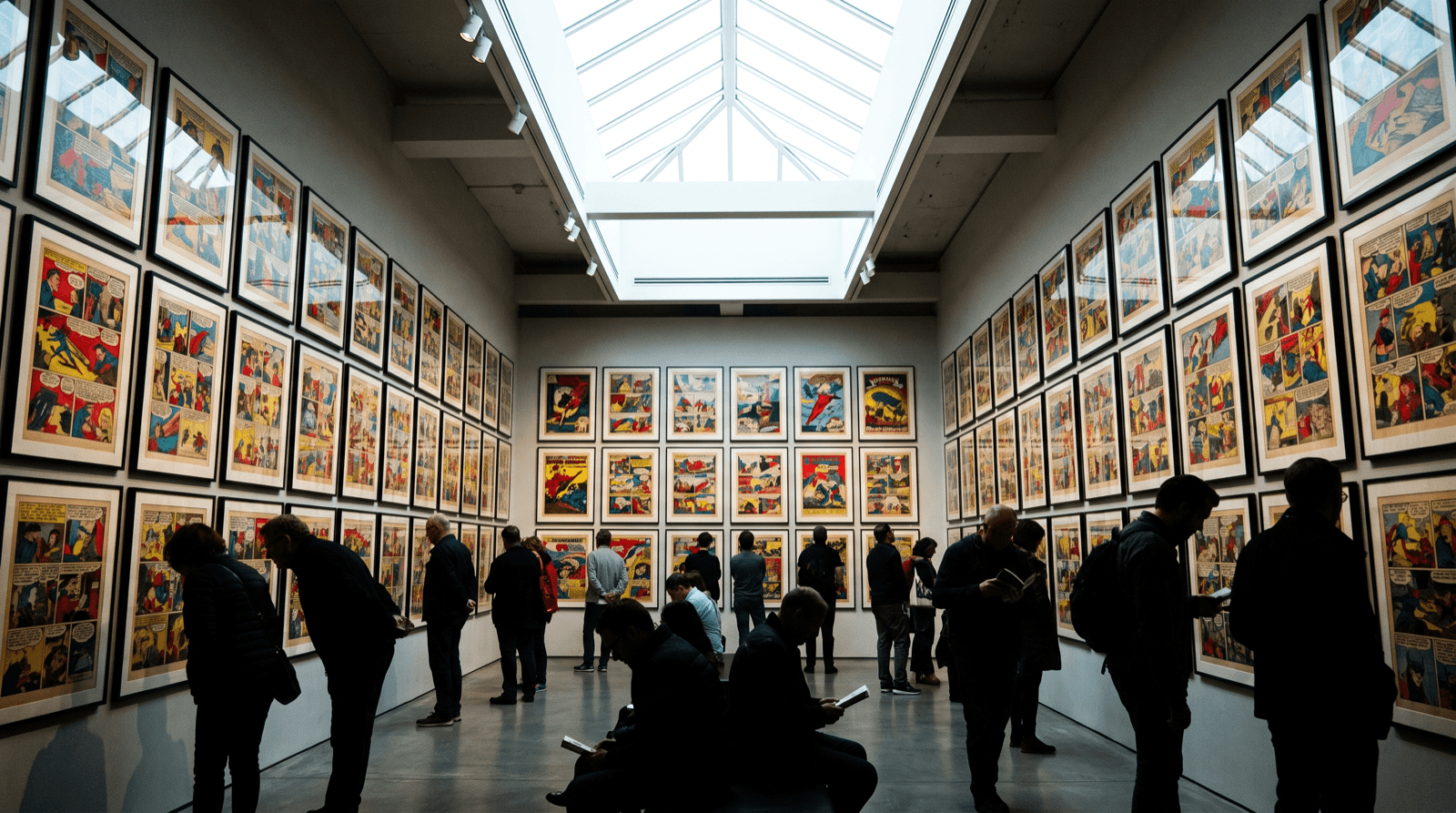
A new exhibition at the Skirball Cultural Center in Los Angeles argues that to leaf through American history, you might start with a comic book. Titled Inventing America: The Comic Book Revolution, the show explores the cultural impact of a uniquely American art form on pop culture and public opinion across the past century. Co-curator Patrick Reed frames the medium as more than a mirror of its times, contending that comic books not only reflect but actually affect popular culture in America. The exhibit runs at the Skirball through February 28, 2027.

The presentation opens by transporting visitors back to the early days of World War II, before America's involvement, set to the recorded voice of Franklin Roosevelt. Reed points out that the pioneering comic book creators of the era were largely first-generation Americans who followed the news from overseas closely and held strong opinions about the war in Europe and the threat of the Third Reich. That charged atmosphere produced one of the medium's defining images, as young Jewish American creators Jack Kirby and Joe Simon brought forth Captain America, whose first issue famously depicted the hero punching Hitler.
Captain America was far from alone in carrying a message. The exhibit recounts how Donald Duck encouraged Americans to buy war bonds and how Wonder Woman ran for president to promote peace, illustrating how quickly a medium first aimed at children became a powerful communication tool. What began as entertainment for kids was soon recognized as a direct line to the public imagination, and creators began using comics to influence opinion, challenge stereotypes and address social issues. Over the decades, Reed notes, comics have wrestled with racism, immigration, the growing counterculture and the generation gap.
That influence did not go unchallenged. The show documents the mid-century backlash, including congressional subcommittee hearings on comic books and juvenile delinquency and a broader social movement to burn, ban and censor comics in an effort to ensure children received the right message. This period reshaped the industry and led to decades of self-regulation. The exhibit treats the controversy not as a footnote but as evidence of just how seriously the culture took the medium's power over young minds.
Rather than retreat, the art form expanded, growing from a few pulp pages into acclaimed graphic novels. Co-curator Michele Urton, deputy director of the museum at the Skirball, points to Art Spiegelman's Maus as a defining example, a deeply moving story of his family and the Holocaust told through the comic book format. The book went on to win a Pulitzer Prize, is now taught in schools across the country and has had an enormous impact on the culture. Its presence in the gallery underscores the exhibit's claim that comics matured into serious literature.

For the curators, the throughline from Captain America and Superman to the present is the way comics have shaped how the world sees America and how Americans see themselves. Urton describes the medium as having defined the nation in many ways, with creators across the 20th century drawing on their lived experiences to tell different kinds of stories. Taken together, she says, those stories offer a sense of the overall culture and what was happening in the country, amounting to the story of America in microcosm.
The co-curators hope visitors leave with a deeper appreciation of comics as a highly effective and accessible form of storytelling, as well as a recognition of the diverse roster of creators behind them. Reed emphasizes the individual voices that make up the tapestry, the great variety of experiences and backgrounds that he says define both comic books and America itself. By centering that variety, the Skirball positions Inventing America as a study of national identity told through one of the country's most democratic art forms.
Reported by Spectrum News.