A murdered lover is reborn as a housefly and sets out to destroy the industrialist who killed him. On paper it is absurd; on screen, Eega became one of the boldest bets in modern Indian cinema, and it paid off completely.
Eega, released on 6 July 2012, is a Telugu-language fantasy action film written and directed by S. S. Rajamouli and produced by Sai Korrapati under Vaaraahi Chalana Chitram. It was filmed simultaneously in Tamil as Naan Ee and released alongside a Malayalam dub titled Eecha on roughly 1,100 screens globally. The film stars Nani as the doomed young lover, Sudeepa as the industrialist who murders him, and Samantha as Bindu, the miniature artist they both orbit. M. M. Keeravani composed the songs and score, with K. K. Senthil Kumar as director of photography.
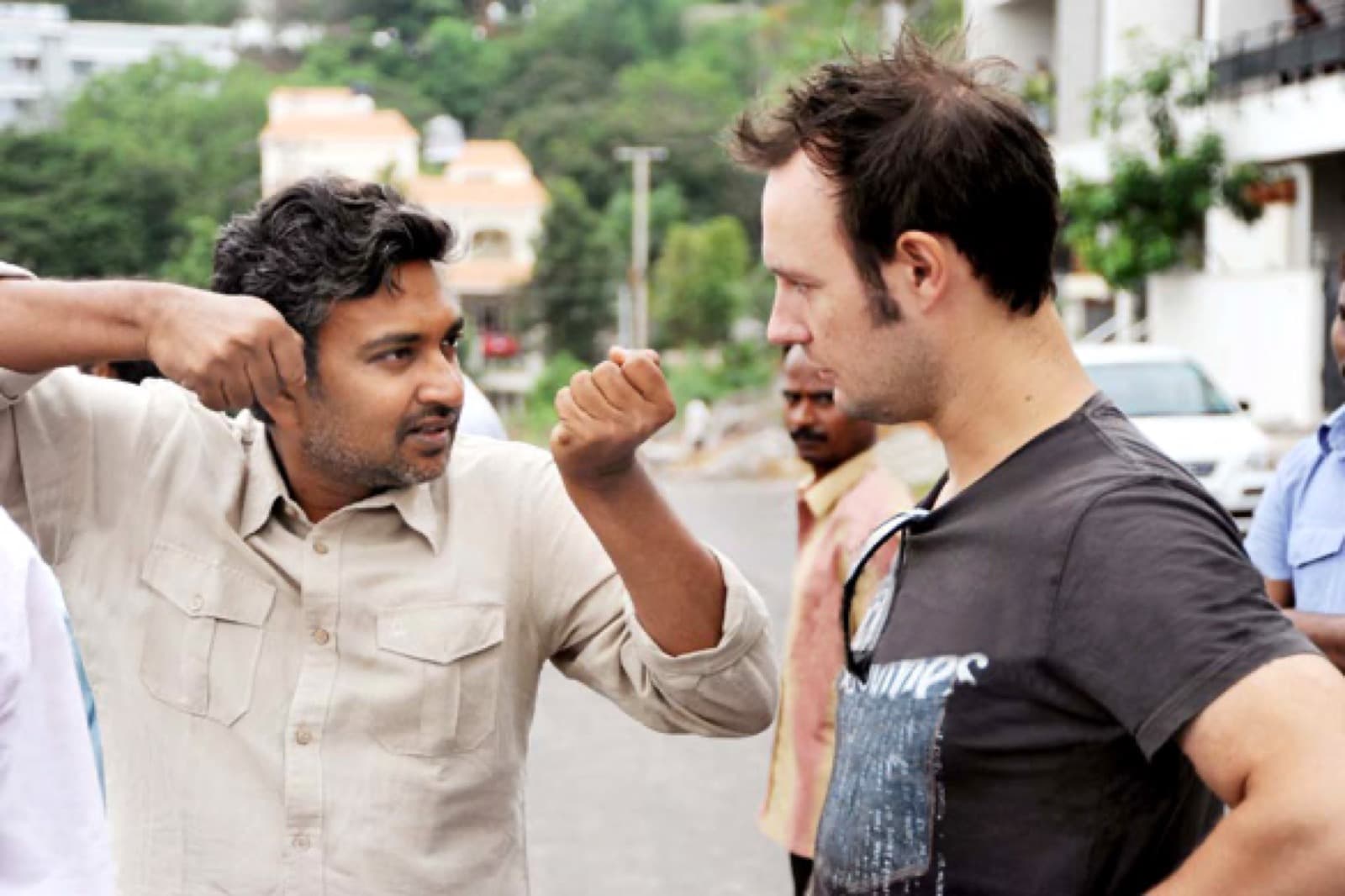
The idea had been buzzing around the Rajamouli household since the mid-1990s, when the director's father and screenwriter V. Vijayendra Prasad joked with him about a fly seeking revenge against a human. Rajamouli returned to the notion after finishing Maryada Ramanna in 2010 and developed it into a full script. Production began on 7 December 2010 at Ramanaidu Studios in Hyderabad, and principal photography ran from 22 February 2011 until late February 2012.
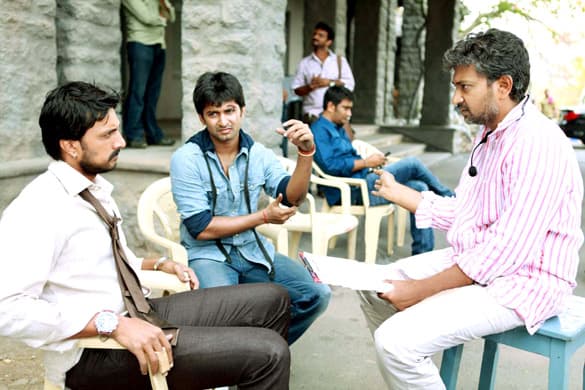
The story is framed as a bedtime tale told by a father to his daughter. Nani, a fireworks maker in love with his neighbour Bindu, is strangled by the jealous industrialist Sudeep and reincarnated as a common housefly with no memory of his past life. As his memories return, the fly dedicates himself to protecting Bindu and psychologically dismantling Sudeep, scratching a death threat onto a shattered windshield and spelling out his identity for Bindu in her own tears. The climax stages a duel between a man with everything and an insect with nothing to lose.
Pulling a photoreal fly protagonist through an action film required infrastructure Telugu cinema was still building. Makuta VFX oversaw the visual effects while Annapurna Studios handled the digital intermediate process. The film's craft earned the National Film Award for Best Special Effects, alongside the National Film Award for Best Feature Film in Telugu. It was a dress rehearsal, in miniature, for the effects pipeline Rajamouli would soon scale up for Baahubali.
Commercially, the gamble worked. Made on an estimated budget of 26 to 40 crore rupees, Eega earned over 125 crore rupees and stood among the highest-grossing Telugu films of its year. The performances of Nani, Sudeep and Samantha, together with Rajamouli's direction and the effects, drew wide critical acclaim. The Hindi market met the film as Makkhi, extending its reach across the country.

The trophy shelf filled quickly. Beyond its two National Film Awards, Eega collected five South Filmfare Awards, including Best Telugu Film, Best Telugu Director, Best Telugu Actress for Samantha and Best Telugu Supporting Actor for Sudeep, plus three South Indian International Movie Awards. On the festival circuit it won nine awards, including Most Original Film at the Toronto After Dark Film Festival. Years later, The Ringer listed Eega among the 25 best foreign films of the decade.
Eega endures because it is a filmmaking dare executed with total sincerity. Rajamouli treated a comic premise with epic logic: real stakes, real grief, real physics for a hero two centimetres long. For a generation of Indian filmmakers it remains the proof of concept that audiences will follow any protagonist anywhere, provided the storytelling never blinks. The fly, improbably, carried the weight of an industry's ambition.
Compiled from public records and festival archives.